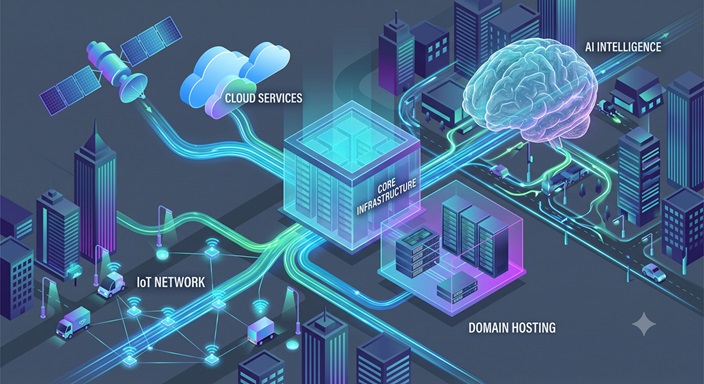
The days of viewing domain hosting, cloud infrastructure, and connected devices as isolated silos are officially over. In 2026, we are witnessing a massive architectural shift. Driven by the explosive demands of Artificial Intelligence and the maturation of the Internet of Things (IoT), the very definition of "the cloud" has fundamentally changed.
Here is what is trending today at the intersection of AI, IoT, cloud services, and domain hosting—and what it means for your digital infrastructure strategy.
1. AI is Breaking Traditional Cloud Assumptions
For years, the cloud was sold as a final destination: move your workloads to a hyperscaler and enjoy elastic, pay-as-you-go compute. In 2026, AI has broken that model.
AI workloads are uniquely data-intensive, long-running, and unpredictable. This reality is forcing the industry to rethink how and where applications are hosted:
-
Data Gravity Reasserts Itself: Storage is no longer a passive layer; it is an active AI performance enabler. Because moving massive datasets frequently is expensive, slow, and risky, system design in 2026 is focused on bringing compute directly to the data.
-
Hybrid is the Default: Nearly half of IT decision-makers are now embracing a "hybrid-by-design" strategy. Organizations are deliberately separating AI experimentation from production. They leverage on-premises, high-density colocation for predictable training costs, while utilizing public cloud burst capacity for sudden spikes in inference.
2. Decentralized Edge Intelligence Meets IoT
The sheer volume of telemetry generated by IoT devices—from smart factories to autonomous fleets—has exhausted traditional network bandwidth. We have moved from centralized cloud reliance to Decentralized Edge Intelligence.
-
Moving to the Concrete: Instead of sending raw data to a distant cloud server, edge computing pushes high-performance processing to the factory floor, pump station, or traffic intersection where the data is actually born.
-
Deterministic Latency: By scrubbing and analyzing data locally through industrial edge gateways, organizations achieve sub-millisecond response times and can slash data backhaul costs by an average of 80%.
-
Offline-First AI: Modern edge AI frameworks are now designed to run entirely offline on resource-constrained IoT devices, intelligently routing to the cloud only during connected windows for workloads that exceed local capabilities.
3. Domain Hosting Evolves into Infrastructure Orchestration
The concept of domain hosting has expanded far beyond standard DNS management and shared web servers. In an ecosystem dominated by distributed edge nodes and microservices, "hosting" now means orchestrating a mesh of localized compute endpoints.
-
Multiagent Systems (MAS): Managing this complexity requires more than human oversight. Multiagent Systems—collections of specialized AI agents working together—are becoming standard for automating complex cloud deployments, scaling edge operations, and enforcing security.
-
Domain-Specific Language Models (DSLMs): Generic AI models often fail at highly specialized network configuration. The hosting industry is rapidly adopting DSLMs fine-tuned specifically for enterprise architecture and IT operations, delivering higher accuracy and compliance for targeted infrastructure needs.
4. The Drive Toward Sustainable Compute
As hyperscale data centers expand to support AI and IoT—expected to make up 61% of all global capacity by 2030—the energy toll is massive. High-performance GPUs generate immense heat, forcing modern hosting facilities to adopt advanced cooling solutions like liquid-air hybrid systems and direct-to-chip cooling.
Ultimately, cloud success in 2026 is no longer measured by how flashy or "cloud-native" an architecture sounds. It is measured by sustainability: consistent performance, clean disaster recovery, and the ability to scale without financial or environmental shock.
The Bottom Line: Infrastructure today isn't about choosing sides between cloud, edge, or on-premises. It is about building resilient, adaptive systems. Whether you are hosting a new web application or deploying thousands of IoT sensors, your underlying architecture must now account for AI's intense resource demands and the necessity of edge processing. The organizations pulling ahead are those treating data locality as a strategic advantage, not just an IT inconvenience.