
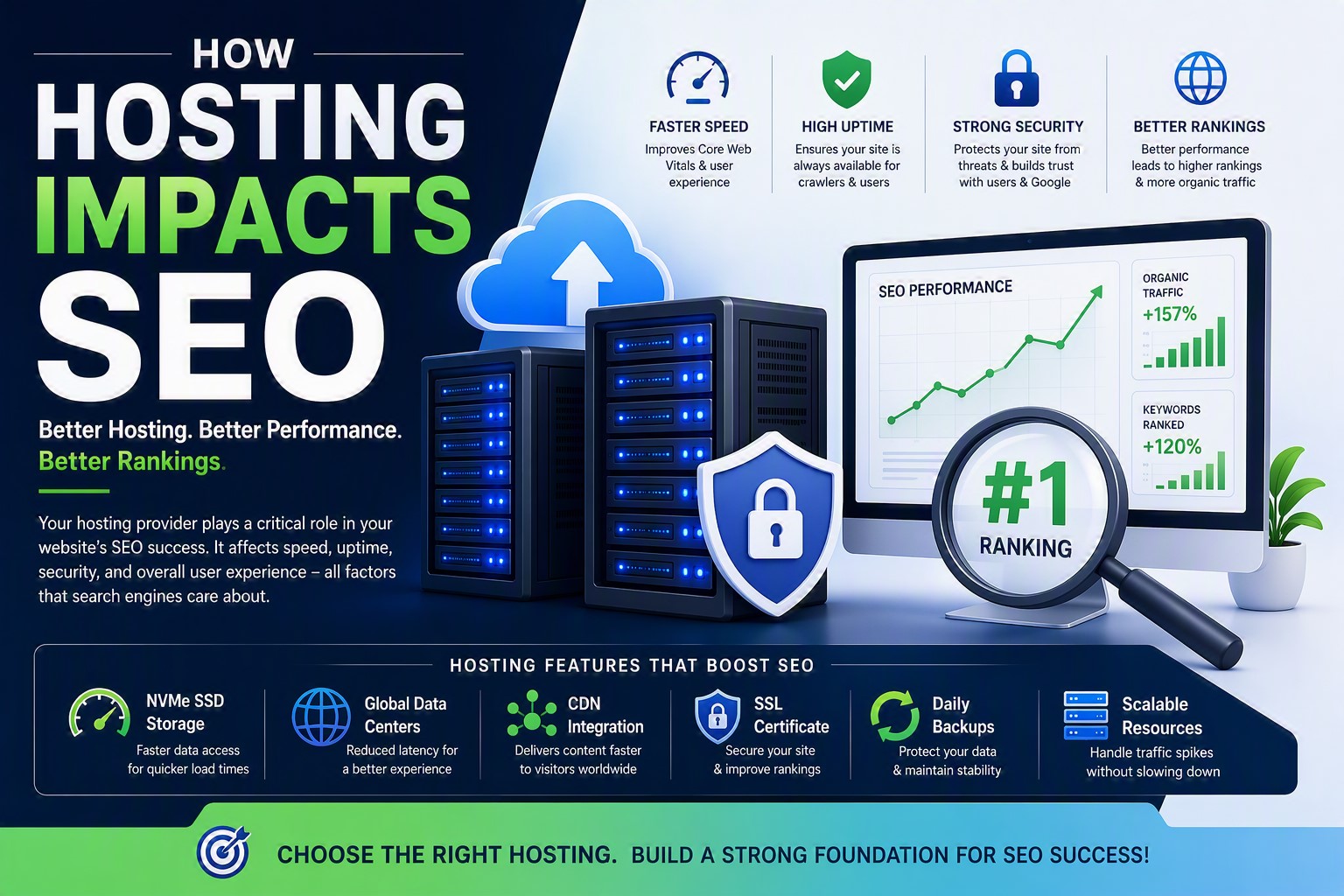
When businesses think about SEO, they usually focus on keywords, backlinks, and content marketing. While those elements are important, many website owners overlook one critical ranking factor: web hosting.
Your hosting provider directly affects website speed, uptime, security, and user experience—all of which influence search engine rankings. A poorly hosted website can struggle to rank, even with excellent content.
In this guide, we'll explain exactly how hosting impacts SEO and what you should look for when choosing a hosting provider.
Does Hosting Really Affect SEO?
The short answer is yes.
Google's goal is to provide users with the best possible experience. If your website loads slowly, frequently goes offline, or presents security risks, search engines may rank competing websites higher.
While hosting itself is not a direct ranking factor, the performance metrics influenced by hosting play a major role in SEO success.
1. Website Speed Directly Impacts Rankings
Website speed is one of the most important SEO factors.
Users expect websites to load quickly. When pages take too long to load, visitors leave, increasing bounce rates and reducing engagement.
A quality hosting provider improves speed through:
- High-performance servers
- NVMe SSD storage
- Advanced caching
- Content Delivery Networks (CDNs)
- Optimized server configurations
SEO Benefits of Fast Hosting
✅ Lower bounce rates
✅ Better user experience
✅ Higher conversion rates
✅ Improved Core Web Vitals
✅ Better search engine rankings
2. Uptime Affects Search Engine Crawling
Search engines regularly crawl websites to index pages.
If Google's crawlers visit your site when it's offline, indexing issues can occur.
Frequent downtime can result in:
- Missing pages in search results
- Reduced crawl efficiency
- Lost organic traffic
- Poor user experience
Professional hosting providers typically offer:
- 99.9% uptime guarantees
- Redundant infrastructure
- Automatic failover systems
- Continuous monitoring
The more available your website is, the easier it becomes for search engines to crawl and index your content.
3. Hosting Impacts Core Web Vitals
Core Web Vitals are Google's performance metrics that measure user experience.
Google pays close attention to:
Largest Contentful Paint (LCP)
Measures loading performance.
Interaction to Next Paint (INP)
Measures responsiveness.
Cumulative Layout Shift (CLS)
Measures visual stability.
A powerful hosting environment helps improve these metrics by delivering faster server response times and reducing delays.
Poor hosting often leads to slow server responses that negatively affect Core Web Vitals scores.
4. Server Location Influences Page Load Times
The physical location of your hosting server matters.
If your website visitors are located in Europe but your server is located on another continent, data must travel farther, increasing latency.
Modern hosting companies solve this problem with:
- Global data centers
- CDN integration
- Edge computing networks
Benefits include:
- Faster page delivery
- Improved user experience
- Better mobile performance
- Reduced loading delays
5. Website Security Protects Your Rankings
Security has become a major SEO concern.
A hacked website can experience severe ranking losses overnight.
Common security problems include:
- Malware infections
- Spam content injections
- Phishing attacks
- Blacklisting by search engines
Reliable hosting providers help protect websites with:
- Free SSL certificates
- DDoS protection
- Malware scanning
- Firewall protection
- Automatic backups
A secure website builds trust with both visitors and search engines.
6. SSL Certificates Improve User Trust
Most quality hosting companies include free SSL certificates.
SSL encryption protects data transmitted between visitors and your website.
Benefits include:
- HTTPS security
- Increased customer trust
- Better user experience
- Improved SEO signals
Websites without SSL often display security warnings that discourage visitors and hurt engagement metrics.
7. Hosting Scalability Supports SEO Growth
Organic traffic growth is exciting—but it can create performance problems.
Many websites rank well and suddenly experience traffic spikes.
Low-quality hosting may struggle under increased demand, leading to:
- Slow loading pages
- Server crashes
- Downtime
- Lost rankings
Scalable hosting environments allow resources to expand automatically as traffic grows.
This ensures consistent performance even during peak traffic periods.
8. Hosting Affects Mobile SEO
Mobile traffic now dominates internet usage.
Google primarily evaluates websites through mobile-first indexing.
A hosting provider with optimized infrastructure helps ensure:
- Faster mobile page speeds
- Better mobile user experience
- Reduced bounce rates
- Higher mobile rankings
If your mobile visitors experience slow loading times, your SEO performance can suffer significantly.
Shared Hosting vs Premium Hosting for SEO
Shared Hosting
Pros
- Affordable
- Good for beginners
Cons
- Slower performance
- Resource limitations
- More security risks
- Variable loading speeds
VPS and Cloud Hosting
Pros
- Faster performance
- Better reliability
- More resources
- Stronger security
- Better SEO potential
Cons
- Higher cost
For businesses focused on long-term SEO growth, cloud hosting or VPS hosting is often the better investment.
Essential Hosting Features for SEO
When choosing a hosting provider, look for:
✅ NVMe SSD Storage
✅ Free SSL Certificate
✅ 99.9% Uptime Guarantee
✅ CDN Integration
✅ Daily Backups
✅ Advanced Security
✅ DDoS Protection
✅ Fast Global Servers
✅ Cloud Scalability
✅ 24/7 Technical Support
These features contribute directly to website performance and SEO success.
Final Thoughts
Your hosting provider plays a larger role in SEO than many business owners realize.
Great content and effective keyword strategies can only take your website so far if your hosting is slow, unreliable, or insecure.
Fast loading speeds, strong uptime, secure infrastructure, and scalable resources create the foundation that allows SEO efforts to succeed.
If you're serious about improving search rankings, generating organic traffic, and growing your online business, investing in high-quality hosting is one of the smartest SEO decisions you can make.